5 posts tagged with "events"

View All Tags

January 2026 Maintenance Update

· 5 min read
Kristen Finch
Director of Research Computing Solutions

During this month’s scheduled maintenance window, we completed several system upgrades and routine updates across Klone and Tillicum to improve stability, performance, and security. The next maintenance is scheduled for Tuesday, February 10, 2026 (the second Tuesday of the month).

Notable Updates

In addition to routine image updates and security patches, we upgraded:

  • Klone login node process enforcement to Arbiter 3 and paused user notifications and Klone and Tillicum (read more below).
  • Klone has been upgraded from cgroups v1 to cgroups v2. This upgrade shouldn't be a noticeable for most users, but in some cases memory accounting under cgroups v2 is unified and includes all file-backed page cache. This difference may make memory usage appear higher or "inflated" compared to v1 in niche cases and some specific Java-based applications.
  • Slurm version 25.11.1 on both clusters.
  • Duo 2FA on Klone (Tillicum already up to date). This change aligns with ongoing UW security upgrades.
Action Required

All University of Washington technology users must update Duo Mobile to version 4.85.0 or later on all registered devices by February 2, 2026. Users who cannot update their devices must register a platform authenticator, a new phone/tablet, or request a hardware token from UWIT. The Duo phone call authentication method is being phased out by the University and no longer available for logging into Klone or Tillicum. 

Check your device’s Duo Mobile application version.

Login Node Usage & Arbiter Enforcement (Important Reminder)

Login nodes are shared community resources intended for:

  • Transferring data
  • Navigating the filesystem
  • Editing and developing code
  • Submitting jobs to the scheduler

As part of this maintenance, Klone was upgraded to Arbiter 3, a tool which automates login node monitoring and enforces usage limits to ensure stability and ensure fair access.

Arbiter monitors resource usage on login nodes and will:

  • Slow or halt processes that exceed permitted thresholds.
  • Terminate processes outright if necessary.

Arbitor email notifications halted

Previously, users received email notifications for each offending process when Arbiter thresholds were exceeded. We have found these notifications are not an effective way to communicate our policies. To avoid notification fatigue, we have stopped sending these emails.

This does not mean enforcement has stopped. Arbiter continues to actively limit, halt, or kill processes on login nodes as needed.

Be a good HPC-citizen - do not connect to a login node

Connecting directly to the login node using tools like VS Code Remote-SSH frequently leads to Arbiter intervention and could cause login node instability since background server processes persist beyond an active session.

Instead, follow our recommended best practices and set up your ProxyJump to connect your local VS Code to Klone or use the streamlined option offered by our Open OnDemand interactive application for VS Code.

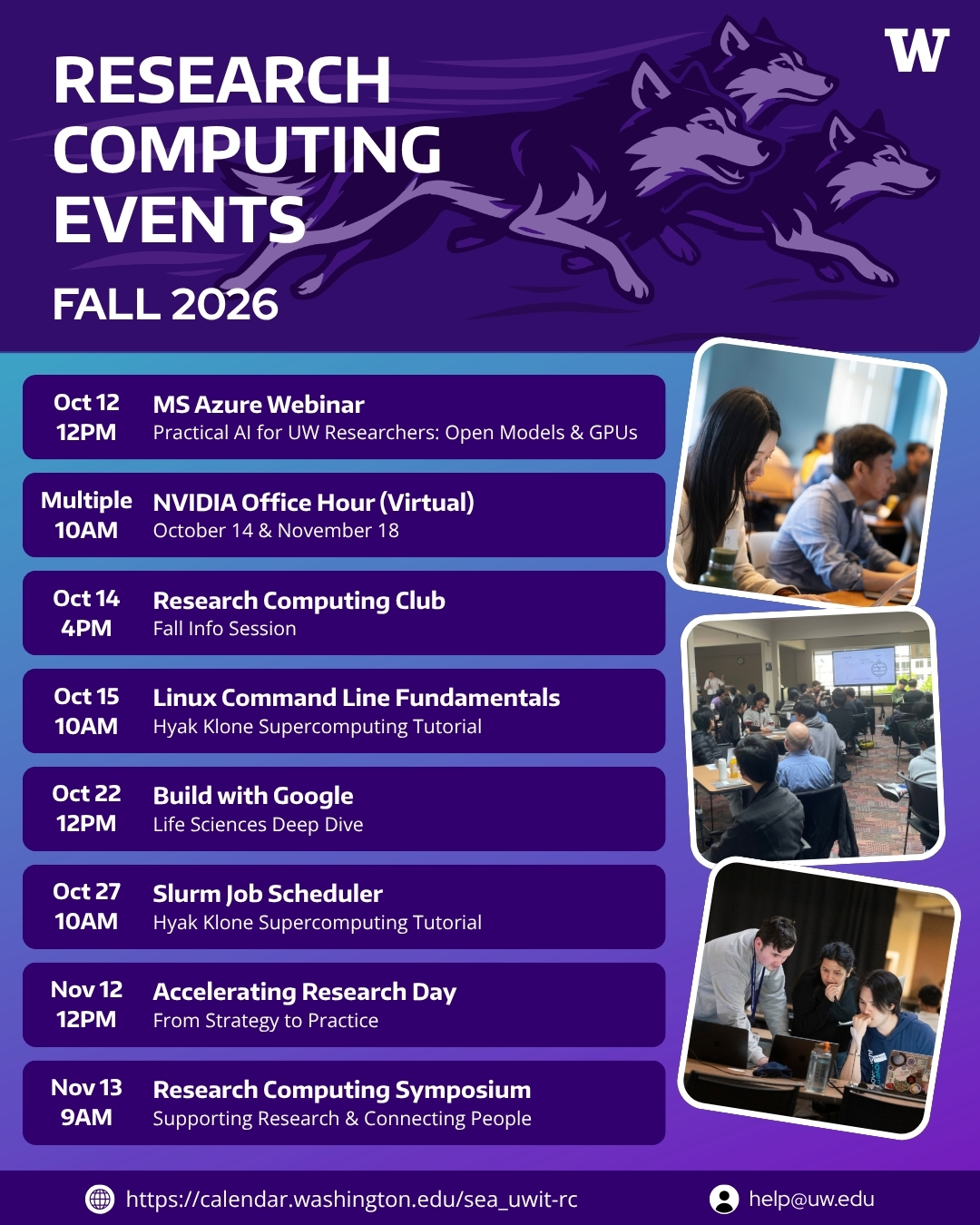
Winter 2026 Computing Workshops

Stay informed by subscribing to our mailing list and the UW-IT Research Computing Events Calendar.

Office Hours

Additional Training Opportunities

Having trouble? Get Research Computing support.

Happy Computing,

Hyak Team

December 2025 Maintenance Update

· 6 min read
Kristen Finch
Director of Research Computing Solutions

During this month’s maintenance window, we conducted routine security updates and performed hardware consolidation in the Data Center. The next maintenance is scheduled for Tuesday, January 13, 2025 (the second Tuesday of the month).

Notable Updates

  • Node image updates – Routine updates and security patches.
  • We also installed new modules:
    • gcc/15.2.0
    • conda/Miniforge3-25.9.1-0 (read more below)

New Feature: Conda Module Now Available on Hyak Klone

This month, we’re excited to announce that the Conda module is now available on Hyak Klone. Previously offered only on Tillicum, the module has now passed testing on Klone and is ready for full use. We highly recommend it as the primary way to manage Python environments on Hyak Klone due to its simplicity, reliability, and improved storage efficiency.

Using the Conda module means:

  • No miniconda installation required. Just load the module and start creating environments.
  • More efficient storage usage, leading to fewer issues with home directory quota limits.
  • Cleaner, isolated Python environments, easier debugging, reproducibility, and environment cleanup.

Below is a quick guide to help you get started.

Conda Environments

Conda allows you to create isolated environments that include specific versions of Python, libraries, and tools.

Load Conda Module

First, load the Conda module:

# remember on Klone, module commands are only available on compute nodes
module load conda

After loading the module, the conda command becomes available. You can now create and manage your own environments.

Create and Manage Conda Environments

For example, create an environment named "myenv" with Python 3.12 and the NumPy package:

conda create --name myenv python=3.12 numpy

Activate the environment to use it:

conda activate myenv

List your available Conda environments:

conda env list

Remove an environment:

conda env remove --name myenv

To install additional packages in myenv environment, use conda install. Conda has several default channels that will be used first for package installation. If you want to use another channel beyond the defaults channel, you can, but we suggest that you select your channel carefully.

warning

By default, the system Conda stores environments in your home directory ($HOME/.conda/envs). We recommend installing Conda environments to your project directory under /gscratch/<group>/<myfolder> due to the limited storage space (10 GB) in your home directory. Please apply the steps by following the instructions below carefully.

Customize Environment and Package Locations

There are two ways to specify where your Conda environments and packages are stored.

Option 1. Use --prefix for explicit paths

Manually set the path to your Conda environment by --prefix and always activate your Conda environment with full path.

module load conda
conda create --prefix /gscratch/<myproject>/<myfolder>/myenv python=3.12
conda activate /gscratch/<myproject>/<myfolder>/myenv
conda install numpy scipy matplotlib
Option 2. Configure defaults in $HOME/.condarc

To make this the default behavior, edit (or create) the file $HOME/.condarc:

envs_dirs:
- /gscratch/<myproject>/<myfolder>/conda/envs
pkgs_dirs:
- /gscratch/<myproject>/<myfolder>/conda/pkgs

This will place all of your environments and package caches in this directory by default, and you won't have to worry about specifying the full prefix to your environment when installing it or activating it.

Installing Packages with pip

You can use pip inside a Conda environment to install Python packages. Our suggested use of pip is inside a conda environment. For example:

module load conda
conda activate myenv
pip install seaborn

This ensures that pip installs packages into the active Conda environment — not globally — making it easy to clean up completely when you are done.

See the best practices from Anaconda for using pip with Conda and pip documentation for more information.

New Tutorials Now Available

This fall, our training sessions focused primarily on Tillicum, our new GPU-accelerated service. However, the core skills and workflows we covered apply equally well to Hyak Klone. With only minor adjustments to file paths or partitions, Klone users can benefit directly from these materials because the overall computing environments are very similar and the tools (modules, Slurm, containers, Python workflows, data management) work the same across both systems. We will offer more Hyak Klone trainings in 2026.

Stay informed by subscribing to our mailing list and the UW-IT Research Computing Events Calendar.

Office Hours

External Training Opportunities

  • The NSF LEVEL UP AI (Launching an Educational Vision to Expand Leadership, Understanding, and Progress in Artificial Intelligence) project brings together educators, researchers, and professionals across the computing community to build a shared vision for expanding capacity and access to AI education. 01/07/26 - 12:00 AM to 01/08/26 - 11:59 PM EST Learn more and register.
  • 2 Postdoc positions in AI with deadlines arriving soon.
  • The eScience Institute offers the annual Winter School to students and lecturers interested in developing basic skills and knowledge of the tools used in data science. Gaining literacy in topics such as Python, R, Jupyter, and reproducible environments can be beneficial beyond STEM, including areas like global or public health, public policy, social sciences, social work, international relations, and business management. There are no prerequisites to take this course and there is no credit offered. Only UW faculty, staff, students (undergraduates and graduates) from all three campuses are welcome to apply. Deadline to apply: February 4th, 2026.

Having trouble? Get Research Computing support.

Happy Computing,

Hyak Team

November 2025 Maintenance Update

· 3 min read
Kristen Finch
Director of Research Computing Solutions

This month’s maintenance window was used for internal testing and system improvement work. We also added Open OnDemand functionality that will enable new users to create and initialize their home directories from the web page. Lastly, we automated the Hyak Klone intracluster SSH key setup process, reducing the manual steps needed for workflows that move between nodes.

Stay informed by subscribing to our mailing list and the UW-IT Research Computing Events Calendar. The next maintenance is scheduled for Tuesday, December 9, 2025 (the second Tuesday of the month).

Upcoming Events

  • Tillicum Containers Workshop November 13 1-3pm – even if you aren’t a Tillicum user, we will review relevant commands and protocols for containers that can be applied to Hyak Klone.
  • AWS Generative AI Unicorn Party GameDay November 20 12:30-7pm – A hands-on competition where you’ll team up to build and deploy real AI solutions using AWS’s latest generative AI tools. Solve fun challenges, create magical applications, and win prizes!
  • Docker Containers Workshop December 2 1-3pm – learn the basics of containerization for research computing using Docker.

Office Hours

  • AWS Office hours – AWS solutions architects will be on Zoom to answer your questions and help you troubleshoot.
  • Hyak and Tillicum Office Hours:
    • Wednesdays at 2pm on Zoom. Attendees need only register once and can attend any of the occurrences with the Zoom link that will arrive via email. Click here to Register for Wednesday Zoom Office Hours.
    • Thursdays at 2pm in person in eScience. (address: WRF Data Science Studio, UW Physics/Astronomy Tower, 6th Floor, 3910 15th Ave NE, Seattle, WA 98195).
  • See our office hours schedule, subscribe to event updates, and bookmark our UW-IT Research Computing Events Calendar.

If you would like to request 1 on 1 help, please send an email to help@uw.edu with "Hyak Office Hour" in the subject line to coordinate a meeting.

External Training Opportunities

  • Cloud Clinic - AI Access in the Cloud 11/18/25 - 2:00 PM - 2:30 PM EST Learn more and register.
  • ACES: Python for Data Scientists 11/25/25 - 11:00 AM - 5:00 PM EST Learn more and register.
  • COMPLECS: Batch Computing (Part III) High-Throughput and Many-Task Computing - Slurm Edition 12/04/25 - 2:00 PM - 3:30 PM EST Learn more and register.
  • Globus and ACCESS: Automating Data and Compute Management Tasks with Globus and ACCESS Resources 12/05/25 - 2:00 PM - 3:00 PM EST Learn more and register.
  • R for HPC 12/09/25 - 2:00 PM - 3:30 PM EST Learn more and register.
  • SpinUp Workshop - December 10 - 18, 2025 SpinUp Workshops are designed to help NERSC users learn how to build their own services on NERSC’s Spin platform. Learn more and register.
  • NERSC, in collaboration with NVIDIA and the OpenACC organization, will host an End-to-End AI for Science bootcamp on December 10 - 11, 2025.
  • The NSF LEVEL UP AI (Launching an Educational Vision to Expand Leadership, Understanding, and Progress in Artificial Intelligence) project brings together educators, researchers, and professionals across the computing community to build a shared vision for expanding capacity and access to AI education. 01/07/26 - 12:00 AM to 01/08/26 - 11:59 PM EST Learn more and register.

Having trouble? Get Research Computing support.

Happy Computing,

Hyak Team

May 2025 Maintenance Update

· 7 min read
Kristen Finch
Director of Research Computing Solutions

During May's maintenance, we've refreshed the operating system images for both login and compute nodes with the latest Linux security updates and patches, and enhanced the node image to include NVIDIA Fabric Manager and software upgrades for next-generation GPU switching fabrics. There’s still time to register for GPU in EDU on Thursday, May 15th, 10:00 a.m.–4:00 p.m., where we team up with NVIDIA and Cambridge Computer for a day of demos, teaching guidance, and research highlights. Stay informed by subscribing to our mailing list and the UW-IT Research Computing Events Calendar. The next maintenance is scheduled for Tuesday June 10, 2025 (AKA the 2nd Tuesday of the month).

Notable Updates

  • Operating system - The images for both the login and compute nodes have been refreshed to incorporate the latest Linux OS security updates and system patches.
  • Node image enhancements - This version of the node image includes NVIDIA Fabric Manager and software upgrades necessary to support next-generation GPU switching fabrics.

Upcoming Events

Subscribe to event updates and bookmark our UW-IT Research Computing Events Calendar.

  • There's still time to sign up for GPU in EDU Thursday May 15th 10:00 a.m. - 4:00 p.m.
    • Join us for a full day of learning about GPUs with experts from NVIDIA and Cambridge Computer. The event will feature recommendations for building GPU workflows, guidance for using GPUs for teaching, highlights of GPU-powered research at UW, and more. Don’t miss it — Lunch is provided! Registration is still open!

Spring Office Hours

If you would like to request 1 on 1 help, please send an email to help@uw.edu with "Hyak Office Hour" in the subject line to coordinate a meeting.

Training Resources

Opportunities

Computing Training from eScience and more

eScience logo.
  • Intro Programming Workshop - eScience is holding a Software Carpentry workshop on May 27th–30th (9:00 a.m. – noon each day). The workshop will teach software tools that can make researchers more effective, automate research tasks, and track research over time. Specifically, the Unix Shell, Git, and Python will be taught with a focus on reproducible research. Register here.
  • Teach your own LLM - On Friday, May 23rd from 10:30 - noon in the Open Scholarship Commons, Jose Cols will lead the workshop “Teach your own LLM: Fine-tuning Models on Custom Datasets” covering how LLMs work and how to fine-tune a Llama 3 model for tasks like sentiment analysis and summarization.

External Training Opportunities

  • COMPLECS: Using Regular Expressions with Linux Tools - Thursday, May 29, 2025 - 11:00 a.m. – 12:30 p.m. (Pacific Time) Regular expressions (regexes) provide a way to identify strings that match a specified pattern. They are extremely useful for preprocessing text and extracting results from high-performance computing and data science workloads. Primarily in the context of the Linux grep utility, we incrementally introduce the main features of regexes: string literals, specifying multiple characters, quantifiers, wildcards, anchors, character classes, grouping, and alternation. We also explore more advanced topics such as word boundaries, lazy and greedy matching, regex flavors (basic, extended, and Perl compatible), regexes with awk and sed, searching compressed files, and using large language models (LLMs) to create regexes. Register here!
  • 8:00 - 11:30 am (Pacific time), Wednesday, May 28, 2025 - LANL is hosting an Accelerated Python Tutorial, presented by Scot Halverson from Nvidia. This will include measuring, understanding, and improving performance of their python applications, including ML workflows using PyTorch and Tensorflow. This event is open to NERSC users. Learn more and register.
  • Building GPU-Accelerated Differentiable Simulations with NVIDIA Warp Python 1- 4 pm (Pacific time), Wednesday, May 28, 2025 - LANL is hosting a Building GPU-Accelerated Differentiable Simulations with NVIDIA Warp Python training, presented by Eric Shi from Nvidia. This approach lets developers harness GPU performance while maintaining the simplicity and flexibility of Python. This event is open to NERSC users. Learn more and register.
  • NERSC GPU Hackathon - NERSC, in conjunction with NVIDIA and the OpenACC organization, will be hosting an Open Hackathon from July 16th-18th with an opening day on July 9th as part of the annual Open Hackathon Series. Please note the deadline to submit a proposal is 11:59 PM Pacific, May 28, 2025. So apply now!.
  • A Deep Dive into the HPC SDK - 1:00 - 4:00 pm (Pacific time), Thursday, May 29, 2025 - LANL is hosting a Deep Dive into the Nvidia HPC SDK Training, presented by Scot Halverson from Nvidia. This talk will cover the broad set of compilers, tools, and libraries that make up the NVIDIA HPC SDK. This event is open to NERSC users. Learn more and register.
  • High Throughput Workflow Tools and Strategies - 8:30 am - 12:00 pm (Pacific time), Friday, May 30, 2025 - NERSC is hosting an online webinar presented by William Arndt of NERSC and Geoffrey Lentner from Advanced Computing, Purdue University. This training session will discuss and demonstrate multiple software tools for managing high throughput workloads: GNU Parallel, Snakemake, and Hypershell. The seminar is open to the general public. Learn more and register.
  • Solving Data Management Challenges with Globus - June 6, 2025, 9 a.m. – 12 p.m. (Pacific Time) Participants will engage in hands-on exercises to explore how Globus can streamline data movement across cloud and high-performance computing systems. Whether managing large datasets, enabling secure collaboration, or automating workflows, this session will equip participants with the knowledge and skills to maximize the benefits of Globus. Enroll here.
  • COMPLECS: Code Migration - Thursday, June 12, 2025 - 11:00 a.m. – 12:30 p.m. (Pacific Time) We will cover typical approaches to moving your computations to HPC resources: using applications/software packages already available on the system through Linux environment modules; compiling code from source with information on compilers, libraries, and optimization flags to use; setting up Python and R environments; using conda-based environments; managing workflows; and using containerized solutions via Singularity. Register here!
  • Automating Research with Globus: The Modern Research IT Platform - Aug. 18, 2025, 9 a.m. – 12 p.m. (Pacific Time) This workshop introduces Globus Flows and its role in automating research workflows. Participants will explore data portals, science gateways, and commons, enabling seamless data discovery and access. Enroll here.

If you have any questions about using Hyak, please start a help request by emailing help@uw.edu with "Hyak" in the subject line.

Happy Computing,

Hyak Team

April 2025 Maintenance Update

· 10 min read
Kristen Finch
Director of Research Computing Solutions

April maintenance included the latest OS patches and security enhancements for login and compute nodes, along with testing endpoint detection and response (EDR) software to strengthen cluster security. We would like to bring your attention to upcoming events featuring an AWS AI in Research Workshop (April 17), our annual Research Computing Club Hackathon (April 19), and the Kopah S3 Storage Launch Event "Data Storage Day" (May 5), showcasing campus-wide S3-compatible storage. Additionally, GPU in EDU (May 15) will provide insights into GPU workflows demonstrated by experts at Cambridge Computer and NVIDIA. Regular office hours are available for research computing support. Stay informed through training resources, event subscriptions, and the UW-IT Research Computing Events Calendar. The next maintenance is scheduled for Tuesday May 13, 2025 (AKA the 2nd Tuesday of the month).

Notable Updates, New Features

  • Operating system - The login and compute node images were updated to address system patches and security updates in the Linux operating system (OS).
  • Security solutions testing - We tested endpoint detection and response (EDR) software as a potential solution for an enhanced cluster security posture. This testing is part of our ongoing efforts to maintain a secure computing environment in line with funding requirements (e.g., NIST-800, CMMC, HIPAA, NIH).
  • Globus - We’re excited to announce that Globus has been added to Hyak Klone and Kopah S3. Globus makes it easy to transfer large datasets reliably and securely between systems, whether across campus or around the world. With features like automated transfers, fault tolerance, and a simple web interface, it’s a powerful tool for streamlining data movement in research workflows.

Upcoming Training and Events

Subscribe to event updates and bookmark our UW-IT Research Computing Events Calendar.

  • AWS AI in Research Workshop - UW-IT Research Computing and eScience Institute will host a workshop introducing how AWS enables AI in research on Thursday, April 17th from 12:00 - 4:00 p.m. in the eScience Institute. Whether you are developing your own models, building off existing models, or you need to implement generative AI, AWS has you covered. Bring your laptop and join us for a couple of engaging sessions followed by a hands-on lab building AI agents. Learn more.

  • RCC Hackathon - The Research Computing Club (RCC), in collaboration with UW-IT Research Computing and the eScience Institute, is excited to host an all-day HPC Hackathon on Saturday, April 19th from 10:00 a.m. – 6:00 p.m. in the eScience Institute. Learn more.

  • Discover Kopah: Your New S3-Compatible Campus Storage Solution at Data Storage Day! Join us on Monday, May 5 from 1:00 – 5:00 p.m. in the eScience Institute for the official Kopah S3 Storage Service Launch Event — your gateway to fast, scalable storage right on campus. Whether you're a researcher handling big data, an instructor managing course materials, or simply someone in need of reliable cloud-like storage, Kopah is designed for everyone. This event will feature live demos of S3-compatible tools like s3cmd, Globus, JuiceFS, Cyberduck, and boto3, and staff will be available to help you get started with Kopah S3. Learn more.

  • GPU in EDU Save the Date Thursday May 15th 10:00 a.m. - 4:00 p.m. – Join UW-IT Research Computing for a day learning about GPUs from the experts at NVIDIA and Cambridge Computer. This event will feature live demonstrations for building your GPU workflows, recommendations for incorporating GPUs into instruction, computing research at UW, and more! Registration link coming soon!

Spring Office Hours

If you would like to request 1 on 1 help, please send an email to help@uw.edu with "Hyak Office Hour" in the subject line to coordinate a meeting.

Training Resources

Opportunities

External Training Opportunities

  • Parallel Computing with MATLAB: Hands on workshop Coming Up April 16 1PM PDT - During this hands-on workshop, we will introduce parallel and distributed computing in MATLAB with a focus on speeding up application codes and offloading computers. By working through common scenarios and workflows using hands-on demos, you will gain a detailed understanding of the parallel constructs in MATLAB, their capabilities, and some of the common hurdles that you'll encounter when using them. SIGN UP! Highlights:

    • Multithreading vs multiprocessing
    • When to use parfor vs parfeval constructs
    • Creating data queues for data transfer
    • Leveraging NVIDIA GPUs
    • Parallelizing Simulink models
    • Working with large data
  • AI in Science Postdoc Workshop - Generative AI systems built upon large language models (LLMs) show great promise as tools that enable people to access information through natural conversation. Scientists can benefit from the breakthroughs these systems enable to create advanced tools that will help accelerate their research outcomes. Last week the UW Scientific Software Engineering Center (SSEC) offered a Generative AI / RAG training opportunity to the Schmidt AI in Science Postdoctoral Fellows. The online tutorial focused on how to utilize the underlying methods in Generative AI to advance scientific research, including the basics of LLMs followed by a demo of using LLMs and RAG for creating a question answering tool based on private data. Learn more.

  • Trainings from Texas A&M University - gain skills that are transferrable to Hyak (Linux, Slurm job scheduler, Open OnDemand, NVIDIA GPU).

    • ACES: Python for Data Science 04/11/25 - 10:00 AM - 04:00 PM CDT - This short course for experienced programmers introduces the Numpy, Pandas, and Matplotlib libraries commonly used to manage and display large datasets in Python. Exercises will be performed in the learner's web browser in Jupyter Notebooks running in the Open OnDemand portal of the ACES cluster. More information about this course at https://hprc.tamu.edu/training/aces_python4data.html.
    • ACES: Metagenomics 04/15/25 - 01:30 PM - 04:00 PM CDT - This short course introduces concepts of metagenomic analyses based on data generated by Next Generation Sequencing (NGS) technology using ACES cluster, a composable accelerator testbed at Texas A&M University. Students will learn to complete a metagenomics pipeline using QIIME2 software. Read more at https://hprc.tamu.edu/training/aces_metagenomics.html
    • ACES: Rust 04/22/25 - 10:00 AM - 12:30 PM CDT - This short course provides an introduction to Rust, a modern systems programming language known for its safety, speed, and concurrency, through hands-on coding exercises and practical examples using the ACES cluster, a composable accelerator testbed at Texas A&M University. Learn more at https://hprc.tamu.edu/training/aces_rust.html
    • ACES: GPU Programming (CUDA) 04/22/25 - 01:30 PM - 04:00 PM CDT - This short course covers basic topics in CUDA programming on NVIDIA GPUs. More information about this Short Course https://hprc.tamu.edu/training/intro_cuda.html Topics include:
      • CUDA architecture
      • basic language usage of CUDA C/C++
      • writing, executing CUDA code.
    • ACES: Python for HPC and Advanced Topics 04/25/25 - 10:00 AM - 04:00 PM CDT - This short course for experienced Python programmers will cover several topics relevant to Python workloads running on HPC systems, including environment and data handling. Exercises will be performed in the learner's web browser in Jupyter Notebooks running in the Open OnDemand portal of the ACES cluster. More information about this course at https://hprc.tamu.edu/training/aces_python4HPC.html.
  • Trainings from the National Energy Research Scientific Computing Center (NERSC) - gain skills that are transferrable to Hyak

    • NERSC N-Ways to GPU Programming Bootcamp - NERSC, in collaboration with the OpenACC Organization and NVIDIA, is hosting an N-Ways to GPU Programming Bootcamp for 3 days from Wednesday, April 30 to Friday, May 2. Beginner users in GPU programming are especially encouraged to attend. This is a virtual event. For detailed information, and how to apply, please refer to Open Hackathons's Bootcamp Events page. The application deadline is April 13, 2025.
    • Building GPU-Accelerated Differentiable Simulations with NVIDIA Warp Python 1- 4 pm (Pacific time), Wednesday, May 28, 2025 - LANL is hosting a Building GPU-Accelerated Differentiable Simulations with NVIDIA Warp Python training, presented by Eric Shi from Nvidia. Warp is a Python framework designed for authoring high-performance, GPU-accelerated code directly in Python. At its core, Warp uses a programming model where Python functions are just-in-time (JIT) compiled into efficient code that can run on both CPUs and NVIDIA GPUs, using C++/CUDA as an intermediate representation. This approach lets developers harness GPU performance while maintaining the simplicity and flexibility of Python. Learn more and register.
    • NERSC GPU Hackathon - NERSC, in conjunction with NVIDIA and the OpenACC organization, will be hosting an Open Hackathon from July 16th-18th with an opening day on July 9th as part of the annual Open Hackathon Series. The NERSC Open Hackathon will be hosted as a hybrid event. Days 0-1 (July 2 and 9) will be held virtually, and attendees will have the option to attend Days 2-4 (July 16 - 18) either in-person at NERSC or online. This hackathon is open to everyone looking to take their projects to the next level; however, priority acceptance will be given to NERSC collaborators. Please note the deadline to submit a proposal is 11:59 PM Pacific, May 28, 2025. So apply now! Please note acceptance is not confirmed until you have received a confirmation email.
    • More opportunities from NERSC

Jobs

  • The UW Echospace research group is seeking a student or an early career professional to help develop open-source scientific software for processing large-scale ocean sonar data to accelerate marine ecosystem research. APPLY!

  • Metascience & AI Postdoctoral Fellowship - The Sloan Foundation is awarding grants of up to $250k to support early career researchers in the social sciences and humanities who are interested in understanding the implications of AI for the science and research ecosystem. Applicants are required to have a faculty mentor based at the research organization where the grant is to be held. Feel free to reach out to eScience for support with identifying a potential UW mentor. Applications due April 10, 2025! Learn more.

  • The Center for Geospatial Intelligence at George Mason University is looking for a Postdoctoral Research Fellow in geospatial data science and machine learning to work on research projects related to large-scale urban simulations and geospatial machine learning.

  • Yale Center for Research Computing is hiring an HPC System Administrator to join the center’s Engineering team to provide hardware and software administration for a growing number of high performance computing (HPC) clusters used in faculty research. This position will support the infrastructure behind all of the above, including hardware, system and resource-management software, networking, storage, monitoring and security measures. This is a highly-collaborative effort, so frequent interaction with other system administrators, research support staff, management, vendors and researchers is a regular part of the role. Learn more.

  • Job opening for a High Performance Computing (HPC) Research Computing Associate at Colby College in Maine. Learn more.

If you have any questions about using Hyak, please start a help request by emailing help@uw.edu with "Hyak" in the subject line.

Happy Computing,

Hyak Team